
Macaron Tower Calculator
Calculate Your Tower
Input your macaron size and tower design to estimate the perfect count for stability and beauty.
Estimated Macaron Count
Ever stared at a towering display of macarons at a bakery and wondered-how many actually fit in a four-tier stack? It’s not just about looks. The number depends on size, spacing, stability, and how the baker actually builds it. There’s no single answer, but there’s a clear pattern most professionals follow.
Standard Macaron Size Matters
Most commercial macarons are between 3.5 and 4 centimeters in diameter. That’s about the size of a large coin. Smaller ones, like 3 cm, are often used for wedding favors or mini dessert tables. Larger ones, over 4.5 cm, are rare and usually custom-made. If you’re stacking them, you need to know what you’re working with.A standard 4-tier tower uses the same size macaron on every level. Mixing sizes makes the tower unstable. Bakers avoid that. So if you’re building one yourself, stick to one size.
How Many Per Tier?
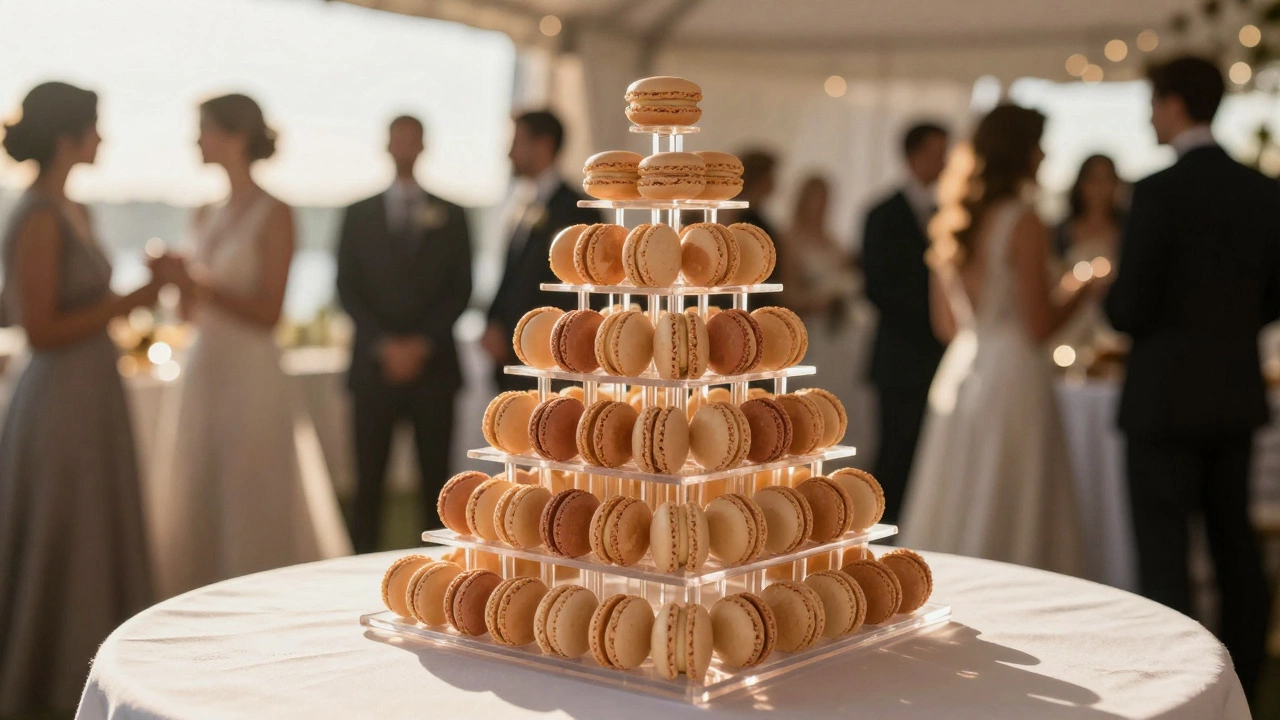
Each tier is a circle of macarons arranged in a ring. The bottom tier is the largest. Each tier above is smaller, with fewer macarons. The top tier usually holds just one or two macarons for visual balance.Here’s the typical breakdown for a 4-tier tower using 4 cm macarons:
- Bottom tier: 16 macarons
- Second tier: 12 macarons
- Third tier: 8 macarons
- Top tier: 4 macarons
Total: 40 macarons.
This is the most common configuration you’ll see in high-end patisseries in Paris, New York, or Tokyo. It looks balanced, doesn’t collapse, and lets each macaron breathe. Too many on a tier, and the weight crushes the ones below. Too few, and it looks sparse.
Why Not More?
You might think, “Why not 20 on the bottom?” Because macarons aren’t bricks. They’re delicate. Their shells are crisp, but the filling is soft. Stack too many, and the bottom ones get crushed under pressure. The filling oozes. The shells crack. The tower becomes a mess.Also, space matters. Macarons need a little room between them-not just for looks, but for airflow. Moisture builds up if they’re packed too tight. That’s how they get soggy. A good baker leaves about 5 mm between each one. That adds up fast on a large tier.
Some bakeries use clear plastic inserts or foam rings to hold the tiers apart. That lets them stack more safely. But even then, they rarely go beyond 16 on the bottom. More than that, and the structure becomes a risk.
What About Different Shapes?
Some bakers use square or hexagonal towers instead of circular ones. That changes the math. A square tier can fit more macarons in the same footprint. For example:- Bottom tier (square): 20 macarons (5 per side)
- Second tier: 16 macarons
- Third tier: 12 macarons
- Top tier: 4 macarons
Total: 52 macarons.
But square towers are harder to build. The corners are weak points. They need internal supports-often hidden dowels or food-safe acrylic rods. Most home bakers don’t attempt this. It’s a pro-level technique.
What’s the Maximum?
The absolute most macarons you’ll see in a 4-tier tower is around 55. That’s a square design with 20 on the bottom, and every tier tightly packed. You’ll only find this at high-end wedding shows or luxury dessert competitions.For everyday use? Stick to 40. It’s the sweet spot. Enough to impress, not so many that it collapses. It’s also easy to transport. A 40-macaron tower fits in a standard cake box with room for padding.
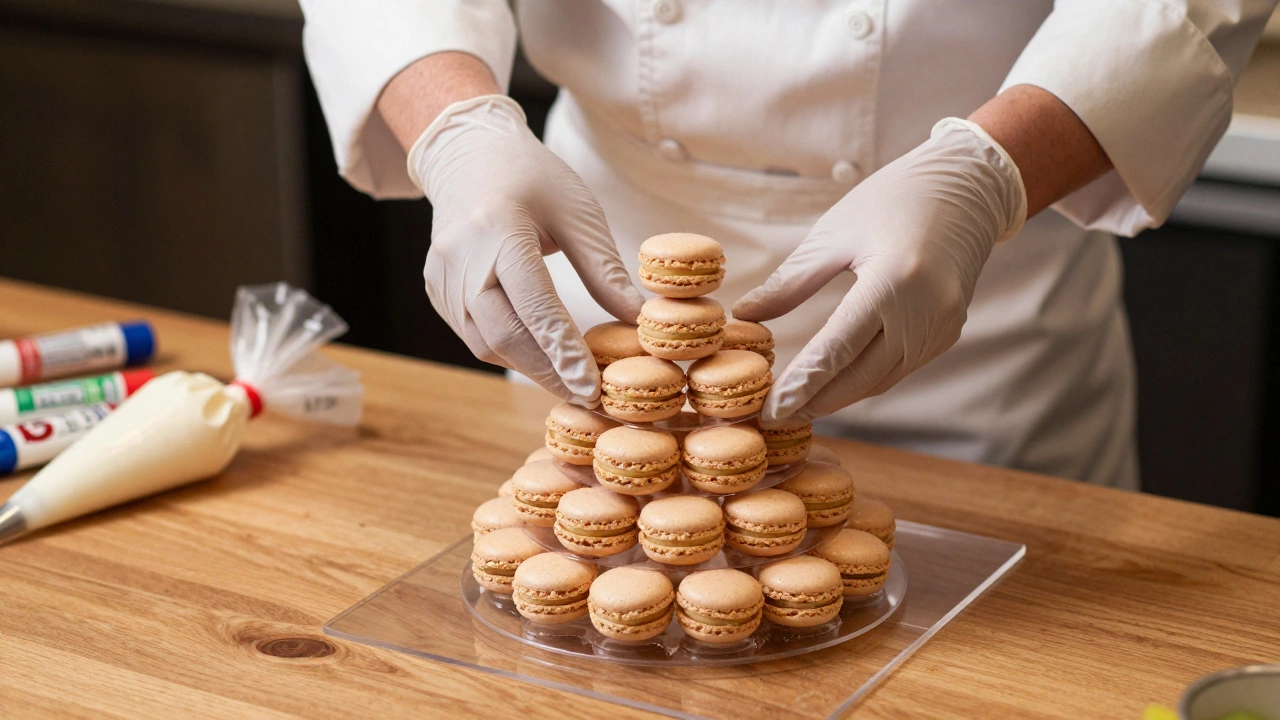
How to Build One Yourself
If you want to try stacking your own:- Use macarons that are at least 24 hours old. Fresh ones are too soft.
- Let them rest in the fridge for 30 minutes before stacking. Cold shells are sturdier.
- Use a sturdy base-a thick cardboard circle or a plastic cake board.
- Place each tier on a thin plastic or acrylic disc. These are sold as cake tier separators.
- Use a dab of royal icing or melted chocolate as glue between tiers. Wait 10 minutes for it to set before adding the next.
- Never move the tower once assembled. Transport it in a box with foam padding.
Pro tip: Don’t refrigerate the finished tower. Condensation forms on the shells. They’ll sweat and lose their shine. Keep it at room temperature, away from heat or humidity.
Real-World Examples
At Ladurée in Paris, their 4-tier towers always have exactly 40 macarons. Same at Pierre Hermé. In the U.S., Magnolia Bakery and Dominique Ansel use the same count. Even in Japan, where macarons are often smaller, the total stays close to 40. It’s not a coincidence. It’s physics.One baker in Melbourne tried stacking 60 macarons on a 4-tier base. The bottom tier cracked during delivery. The client got a pile of broken shells and a refund. That’s why professionals stick to the formula.
What If You Want More?
If you need more than 40 macarons for an event, don’t build one giant tower. Build two smaller ones. Or use a display stand with multiple towers. It looks more elegant, and it’s safer. Plus, guests can reach them without risking a collapse.Some caterers use acrylic stands with 4 separate columns, each holding a single tier. That’s 16 macarons per column × 4 columns = 64 total. No risk. All visible. All delicious.
Final Answer
For a stable, beautiful, and practical 4-tier macaron tower using standard 4 cm macarons, the answer is 40. That’s the number most professionals use. It’s the balance between visual impact and structural integrity. Deviate from it, and you’re not being creative-you’re risking a pastry disaster.Stick to 16-12-8-4. It’s tried. It’s true. And it works.
Can I use different sized macarons in a 4-tier tower?
No. Mixing sizes makes the tower unstable. The weight distribution gets uneven, and the smaller macarons on top can’t support the pressure from below. Always use the same size for every level.
How long can a macaron tower sit out before it gets soggy?
A properly made macaron tower can sit out for up to 6 hours at room temperature, as long as the humidity is below 50%. In humid climates, limit it to 3 hours. Always keep it away from direct sunlight or heat sources.
Do I need special tools to build a macaron tower?
You need a sturdy base, tier separators (plastic or acrylic discs), and a way to glue the tiers together-like royal icing or melted chocolate. A cake turntable helps with alignment. No fancy tools are required, but patience is essential.
Why do macarons sometimes crack in a tower?
Cracks happen when the shells are underbaked, too thin, or exposed to moisture. In a tower, the bottom macarons get crushed under weight. Always let macarons rest for 24 hours before stacking, and never stack them while warm.
Can I refrigerate a macaron tower?
No. Refrigeration causes condensation on the shells, making them sticky and dull. If you must store it, keep it in a cool, dry place. If refrigeration is unavoidable, cover it loosely with parchment paper and let it come to room temperature for 2 hours before serving.