Candy Temperature Calculator
Check Your Candy Temperature
Ever bought a box of candies labeled "fudge" only to bite into something hard and chewy that made your teeth ache? Or picked up a piece of toffee thinking it’d melt like chocolate, only to get a crunchy shock? You’re not alone. Toffee and fudge look similar - both are sweet, often chocolatey, and come in little squares - but they’re not the same. Not even close. And if you’re trying to make them at home, mixing them up can ruin your whole batch.
It’s All About the Cooking Process
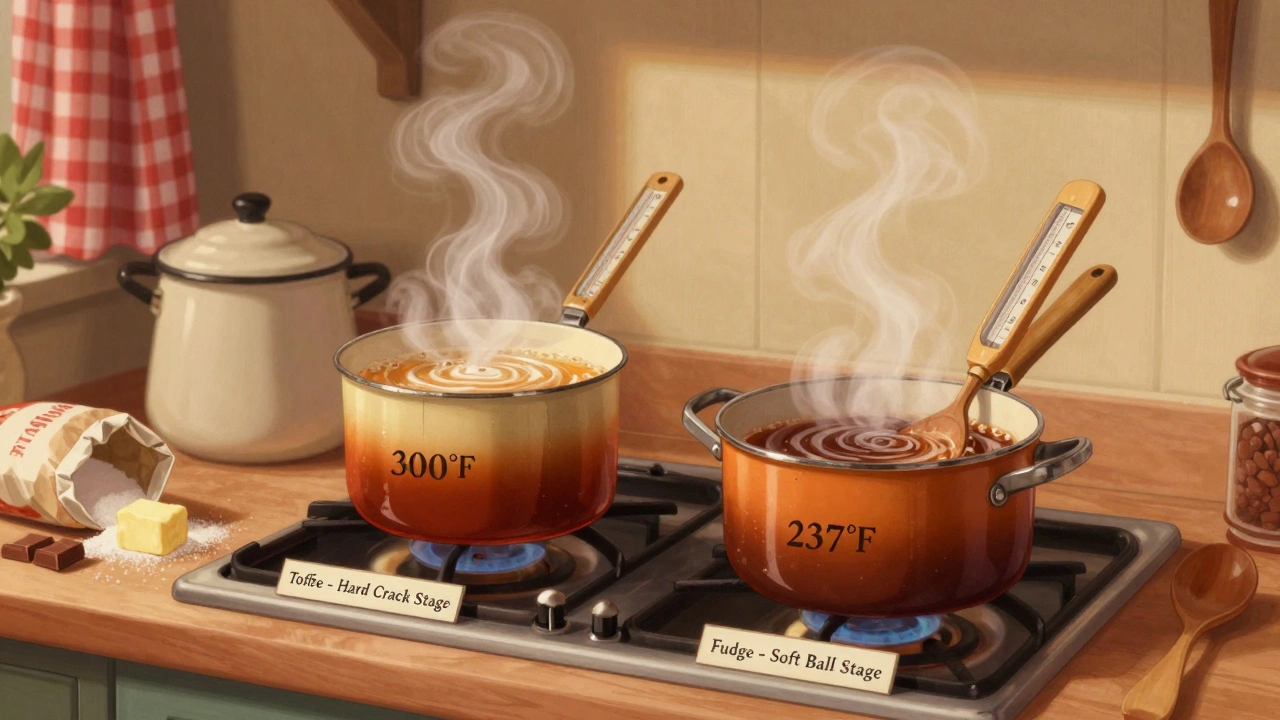
The biggest difference between toffee and fudge isn’t the ingredients - it’s the heat. Toffee is cooked to a much higher temperature than fudge. When you make toffee, you’re aiming for the hard crack stage - that’s around 300°F (149°C). At that point, the sugar syrup turns brittle and snaps when you bend it. That’s why toffee feels like a candy bar you need to chip at.
Fudge, on the other hand, stops at the soft ball stage - about 235°F to 240°F (113°C to 116°C). That’s the same temperature used for making marshmallows or caramel sauce. At this stage, the sugar forms a soft, pliable mass that sets into a creamy, melt-in-your-mouth texture. No chipping required.
That five-degree difference might sound small, but it changes everything. Too much heat on fudge? You get hard, grainy blocks. Not enough heat on toffee? You get sticky, gooey mess that won’t hold its shape.
Ingredients: Sugar, Butter, and What Else?
Both recipes start with sugar and butter. That’s where the similarities end. Toffee usually adds a splash of vanilla and sometimes a pinch of salt - that’s it. The magic happens when the sugar and butter caramelize together. You’re essentially making a hard caramel, then often pressing nuts into it while it’s still warm. Almonds and pecans are classic.
Fudge leans heavier on dairy. You need milk, cream, or evaporated milk - something with fat and moisture to keep it soft. Chocolate is almost always added, either as chips or chopped bars. Some recipes use marshmallow fluff for extra silkiness. No nuts? Fine. But skip the dairy? You won’t get fudge. You’ll get something closer to hard candy.
Here’s a quick look at how they stack up:
| Feature | Toffee | Fudge |
|---|---|---|
| Texture | Hard, brittle, crunchy | Soft, creamy, melt-in-mouth |
| Primary Cooking Temp | 300°F (149°C) - hard crack stage | 235-240°F (113-116°C) - soft ball stage |
| Key Dairy Ingredient | Butter only | Milk, cream, or evaporated milk |
| Chocolate? | Optional - often added on top | Almost always included |
| Common Add-ins | Pecans, almonds, sea salt | Chocolate chips, marshmallow, nuts, vanilla |
| Shelf Life | Up to 3 weeks in airtight container | 1-2 weeks, best kept refrigerated |
Why Does Fudge Get Grainy?
If your fudge turns out gritty, you didn’t mess up the recipe - you messed up the stirring. Fudge relies on tiny, uniform sugar crystals to stay smooth. If you stir it while it’s hot, you trigger big crystals to form. That’s the graininess. The trick? Don’t touch it until it cools to about 110°F (43°C). Then, stir like you mean it - for 5 to 10 minutes - until it thickens and loses its shine. That’s when the magic happens.
Toffee doesn’t care about stirring. Once it hits 300°F, you pour it out and leave it alone. Stirring now would just make a mess. The sugar is already set. It’s done.
Can You Substitute One for the Other?
Not really. If you swap fudge for toffee in a recipe, you’ll end up with something too soft to hold shape. Try to use toffee in place of fudge on a brownie? You’ll get crunchy chunks that don’t blend. They’re not interchangeable.
But you can combine them. A layer of fudge under a crackly toffee topping? That’s a showstopper. Some bakeries in Halifax do this with dark chocolate fudge and sea salt toffee - it’s rich, balanced, and totally addictive. If you’re feeling adventurous, try it.
How to Tell Them Apart When You’re Buying
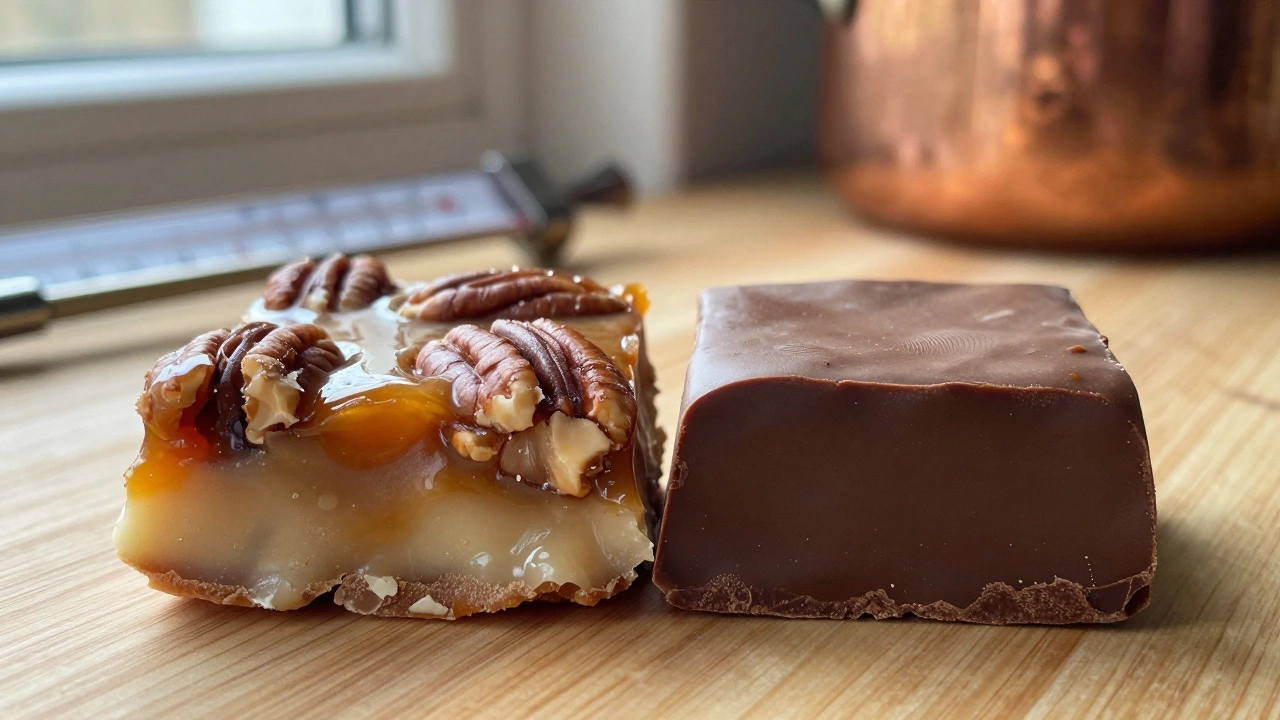
At the candy store, look at the edges. Toffee usually has a glossy, glass-like surface. It’s often broken into irregular pieces. If it snaps cleanly when you press it, it’s toffee. Fudge is matte, slightly dull. It bends a little before breaking. If it leaves a greasy fingerprint, it’s fudge.
And taste? Toffee tastes like burnt sugar and butter - deep, caramelized, almost smoky. Fudge tastes like sweet milk chocolate with a buttery finish. One makes you reach for water. The other makes you close your eyes.
What About Caramel?
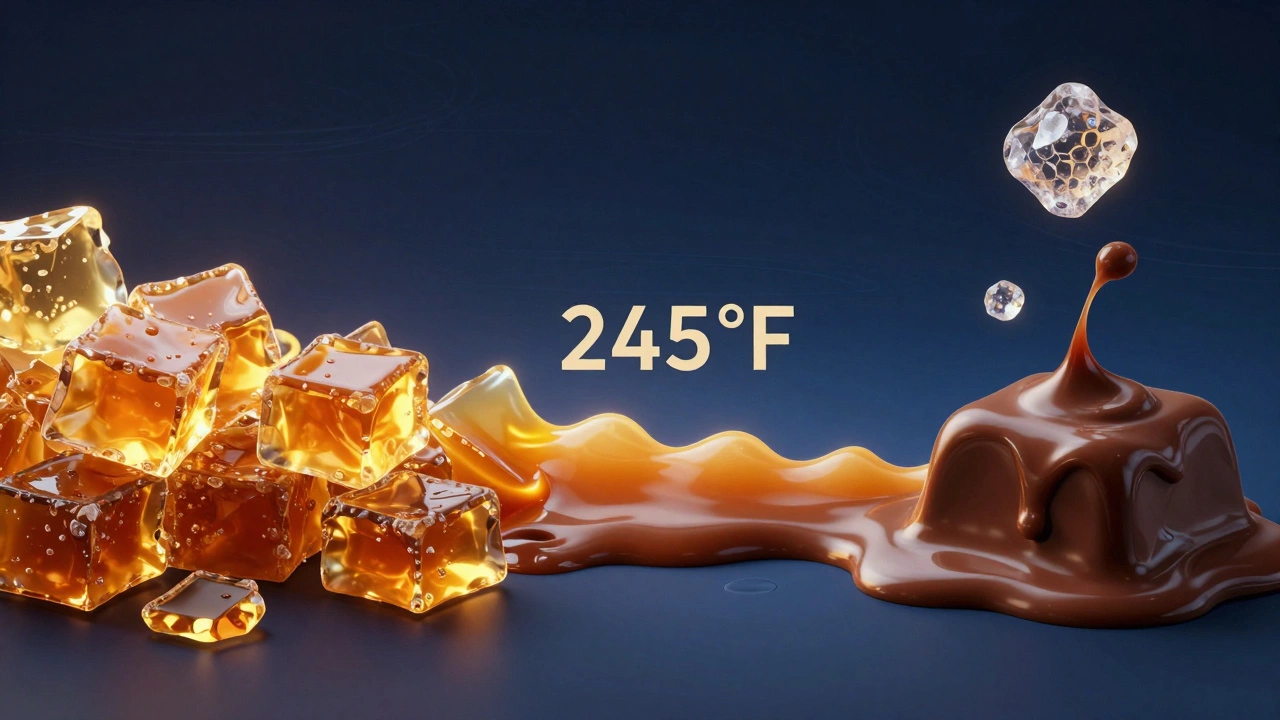
People mix up caramel, toffee, and fudge all the time. Caramel sits between them. It’s cooked to around 245°F (118°C) - the firm ball stage. It’s chewy, not crunchy like toffee, and not creamy like fudge. Think of caramel as the middle child. Toffee is the tough older sibling. Fudge is the soft baby.
If you see a candy labeled "caramel fudge" or "toffee caramel," it’s probably a hybrid. Don’t trust the name. Look at the texture. That’s the real clue.
Best Way to Make Fudge at Home
Start with a good recipe - one that uses evaporated milk and real chocolate. Don’t skip the candy thermometer. Even a $10 one makes all the difference. Heat slowly. Don’t rush. Let it come up to 237°F. Then take it off the heat. Wait until it cools to 110°F. Then stir until it thickens. Pour into a greased pan. Let it sit overnight.
Some people swear by the microwave method. It’s faster, but less reliable. If you’re serious about fudge, use the stovetop. It’s the same method used in old-school candy shops in Quebec and Nova Scotia. You’ll get smoother results, and you’ll understand why it works.
What to Do If You Messed Up
Accidentally cooked your fudge to 250°F? It’s probably grainy. Don’t toss it. Melt it down with a splash of cream, bring it back to 235°F, and start over. You can save it.
Overcooked your toffee? If it’s too dark and bitter, you can still use it as a topping for ice cream or blend it into cookie dough. Burnt toffee still has flavor - it just needs a partner.
Undercooked toffee? It’s sticky. Put it in the fridge for an hour. It might firm up enough to break into pieces. If not, call it caramel sauce and pour it over pancakes.
Can I make fudge without chocolate?
Yes, but it won’t be traditional fudge. You can make vanilla fudge with marshmallow fluff, condensed milk, and butter. It’s called "white fudge" and it’s popular in the Midwest. It’s sweet, creamy, and holds its shape. But if you skip the chocolate entirely, you’re making a different kind of candy - not the kind most people think of when they say "fudge."
Is toffee the same as butterscotch?
No. Butterscotch is made with brown sugar and butter, cooked to the soft crack stage (around 270°F). Toffee uses white sugar and goes higher - to hard crack. Butterscotch is softer, chewier, and has a molasses-like depth. Toffee is sharper, cleaner, and crunchier. They’re cousins, not twins.
Why does fudge need to be refrigerated?
Fudge has dairy and moisture in it. Left at room temperature, especially in humid places like Halifax, it can get sticky or even grow mold after a week. Refrigeration keeps it firm and fresh. Just let it sit out for 10 minutes before eating - it tastes better at room temp.
Can I use fudge in baking?
Yes, but carefully. Crumbled fudge works well as a mix-in for cookies or brownies. Melting it into cake batter? Risky. The moisture content can throw off the recipe. Better to swirl it in as a swirl or use it as a topping. It’s not a direct substitute for chocolate chips.
How long does homemade toffee last?
Stored in an airtight container at room temperature, toffee lasts about 3 weeks. It doesn’t go bad - it just gets sticky if the air is humid. Keep it in a cool, dry place. If you live near the ocean like Halifax, toss in a silica gel packet. It helps.
Final Thought: It’s About Texture, Not Taste
At the end of the day, toffee and fudge aren’t competing. They’re different tools for different moods. You want something that crunches? Go for toffee. You want something that melts slowly on your tongue? Fudge. One is for crunching on while watching snow fall. The other is for savoring after dinner with a cup of tea.
Try making both this weekend. Use the same pan. Use the same sugar. Watch how heat changes everything. That’s the real lesson here. Candy making isn’t magic - it’s science. And once you get it, you’ll never buy store-bought again.