

Brazilian vs. Italian Tiramisu Creator
Select your preferred ingredients below to see how your tiramisu compares to the traditional Italian classic versus the popular Brazilian adaptation.
Design Your Dessert
Analysis Result
Make your selections and click "Analyze" to see your dessert profile.
You might think Brazilian tiramisu is just a copy of the Italian classic. But if you take a bite of the version served at a bakery in São Paulo or Rio de Janeiro, you’ll taste something distinct. It’s sweeter, often uses different cheeses, and sometimes skips the coffee entirely. This isn’t a mistake; it’s an evolution. The story of how Italy reshaped Brazilian desserts is one of migration, adaptation, and local ingredients taking center stage.
Between 1889 and 1934, nearly 1.5 million Italians immigrated to Brazil. They didn’t just bring suitcases; they brought recipes, techniques, and a deep love for dairy. Today, that legacy lives on in every slice of cake and spoonful of pudding. But did Brazil simply copy-paste Italian menus? Absolutely not. Let’s look at what actually happened when these two culinary cultures collided.
The Great Italian Migration and Its Kitchen Impact
To understand the dessert, you have to understand the people. Most Italian immigrants arrived in the late 19th century to work on coffee plantations. When those contracts ended, many moved to cities like São Paulo, which has the largest Italian population outside of Italy. They opened small cafes and bakeries. These places needed to serve affordable, comforting food to workers who missed home but had new local resources.
This economic reality drove innovation. Authentic Italian ingredients were expensive or unavailable. So, bakers improvised. They used local fruits, cheaper sugars, and available dairy products. This necessity created a hybrid cuisine. For example, while traditional Italian cannoli use ricotta, Brazilian versions often blend it with cream cheese or condensed milk to make it smoother and sweeter, matching the local palate’s preference for higher sweetness levels.
Tiramisu: From Treviso to Tropical Adaptation
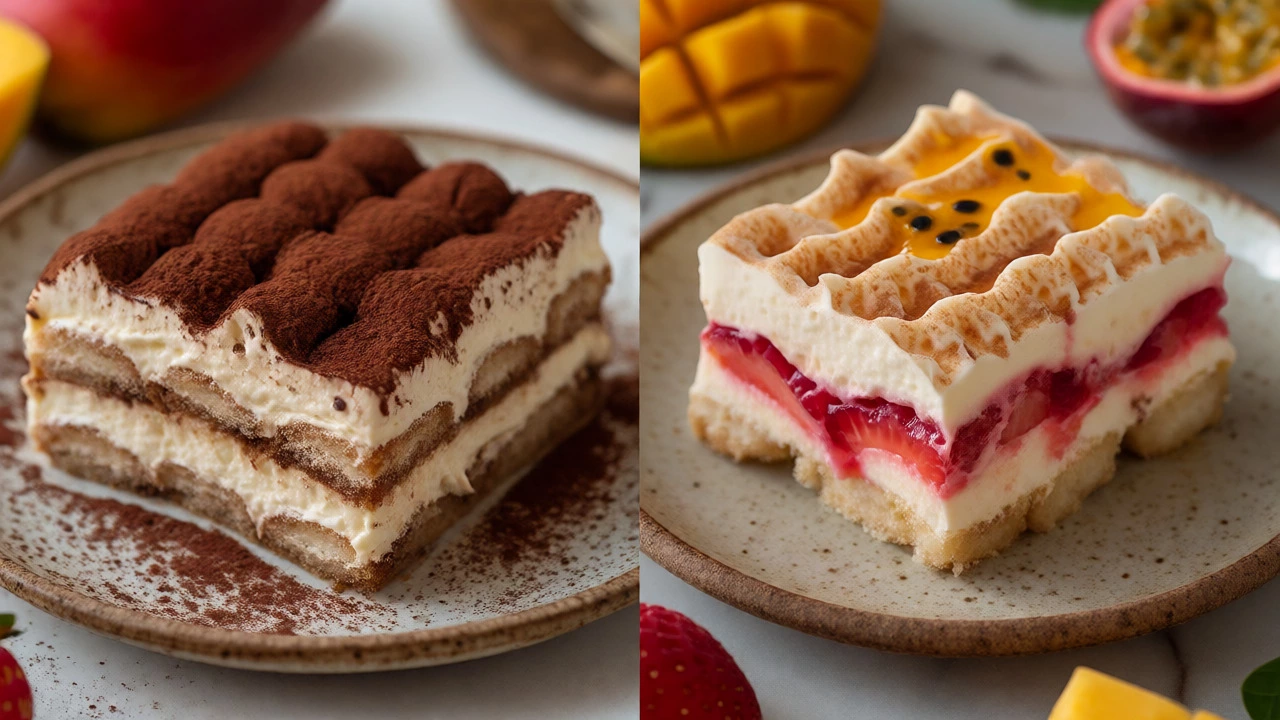
Tiramisu is a coffee-flavored layered dessert from northern Italy, made with ladyfingers dipped in coffee, layered with a whipped mixture of eggs, sugar, and mascarpone cheese. It became globally famous in the 1980s, but its journey to Brazil started earlier through immigrant communities. In Italy, tiramisu is strictly defined. It uses mascarpone, espresso, savoiardi (ladyfingers), and cocoa powder. No fruit. No gelatin. Just those four elements.
In Brazil, however, tiramisu underwent a radical transformation. Why? Because Brazilians love fruit and creamy textures. You will frequently find "Tiramisu de Frutas" (Fruit Tiramisu) where the coffee layer is replaced with passion fruit, strawberry, or mango puree. The mascarpone is often swapped for Cream Cheese, a soft, mild-tasting cheese made from milk and cream, widely used in Brazilian baking as a more accessible alternative to mascarpone. This substitution makes the dessert lighter and tangier, cutting through the intense sweetness of Brazilian condensed milk.
| Feature | Traditional Italian | Brazilian Adaptation |
|---|---|---|
| Cheese Base | Mascarpone | Cream Cheese, Ricotta, or Condensed Milk mix |
| Liquid Layer | Espresso Coffee | Coffee, Fruit Juice, or Liqueur (like Cachaça) |
| Sweetener | Granulated Sugar | Condensed Milk or Brown Sugar |
| Fruit Addition | Rare (usually none) | Common (Strawberry, Passion Fruit, Mango) |
| Texture | Dense, Rich | Airy, Creamy, Often Mousse-like |
Beyond Tiramisu: Other Italian-Brazilian Hybrid Desserts
Tiramisu is just the tip of the iceberg. Several other desserts show clear Italian DNA but wear Brazilian clothes. Take Pudim, the Brazilian version of flan, typically made with condensed milk, eggs, and caramel sauce, often served with a sprinkle of grated coconut. While flan exists across Europe and Latin America, the Brazilian pudim relies heavily on sweetened condensed milk, an ingredient popularized by Swiss-Italian dairy companies in the early 20th century. The result is denser and sweeter than the French crème caramel.
Then there is Pastel de Nata's cousin, the Brigadeiro. Wait, Brigadeiro isn't Italian? Not directly. But the technique of cooking condensed milk with butter and chocolate until it forms a fudge-like consistency mirrors Italian cioccolato preparations adapted for tropical climates where chocolate melts easily. The obsession with rolled, coated sweets also echoes Italian truffles (tartufi), though Brigadeiros are made from scratch rather than using leftover cake crumbs.
Another strong contender is Torta Caprese (Caprese Cake). Originating from the island of Capri, this flourless almond and chocolate cake found a second home in Southern Brazil. Here, it is often made with hazelnuts instead of almonds because hazelnuts grow better in the cooler southern states like Rio Grande do Sul. It remains gluten-free naturally, a trait that aligns well with modern health trends in Brazil.
Why Did Brazil Change the Recipes?
It wasn't just about availability. It was about preference. The Brazilian palate leans significantly toward sweetness. According to data from Euromonitor International, Brazil is one of the highest per-capita consumers of sugar in the world. A traditional Italian tiramisu might seem bland or bitter to a typical Brazilian consumer expecting a sugary treat. Adding condensed milk bridges that gap.
Also, climate plays a role. Northern Italy is cool; Southern Brazil is hot and humid. Heavy, dense desserts melt quickly and feel too rich in the heat. Brazilians adapted by adding air-whipping creams into mousse-like consistencies-and incorporating acidic fruits like passion fruit (maracujá) to cut through the fat. This creates a balance that feels refreshing rather than heavy.

How to Make a Brazilian-Style Tiramisu at Home
If you want to try this fusion yourself, don’t stress about finding authentic mascarpone. Here is a simple method that captures the Brazilian twist:
- Prepare the Base: Instead of dipping ladyfingers in strong espresso, dip them in a mix of weak coffee and a splash of Baileys or even Cachaça (Brazilian sugarcane spirit).
- The Cream: Whip 200g of cream cheese with 1 can of sweetened condensed milk and 1 cup of heavy cream until stiff peaks form. This replaces the egg-yolk-heavy Italian custard.
- Layering: Spread half the cream over the first layer of biscuits. Add sliced strawberries or passion fruit pulp. Repeat layers.
- Finish: Dust with cocoa powder, but consider mixing it with a little powdered sugar to reduce bitterness.
This version is faster, requires no raw eggs, and tastes unmistakably Brazilian while nodding to its Italian roots.
The Cultural Legacy: More Than Just Food
The influence goes beyond specific recipes. It changed how Brazilians eat. The concept of aperitivo-drinking wine or cocktails with snacks before dinner-is now common in major Brazilian cities, thanks to Italian culture. Bakeries (padarias) became social hubs, mirroring the Italian café culture. You go there not just to buy bread, but to chat, read the news, and eat a pastry.
Furthermore, the emphasis on fresh, high-quality ingredients in Italian cooking raised the bar for Brazilian gastronomy. Chefs began paying more attention to sourcing, leading to the rise of farm-to-table movements in regions like Minas Gerais and Santa Catarina, which have strong Italian heritage.
Is Brazilian Tiramisu authentic Italian food?
No, it is a fusion dish. While inspired by the Italian original, Brazilian tiramisu typically substitutes mascarpone with cream cheese or condensed milk and often includes fruits. It represents the adaptation of Italian techniques to local Brazilian tastes and available ingredients.
Why do Brazilians use condensed milk in desserts?
Condensed milk became popular in Brazil in the early 20th century due to industrialization and preservation needs in a tropical climate. It provides sweetness and a creamy texture without requiring refrigeration for storage, making it ideal for both home cooks and commercial bakeries.
What is the most famous Italian-Brazilian dessert?
While Tiramisu is globally recognized, Pudim (flan) and Brigadeiro are arguably more ubiquitous in daily Brazilian life. However, among explicitly Italian-derived desserts, Tiramisu and Torta Caprese hold significant cultural status.
Can I make Brazilian Tiramisu without coffee?
Yes. Many Brazilian variations replace the coffee-soaked ladyfingers with biscuits soaked in fruit juice, liqueurs, or even plain milk. Passion fruit and strawberry versions are extremely common and skip coffee entirely to highlight the fruit flavor.
Did all Italian immigrants come from the same region?
No. Most came from Veneto, Campania, and Calabria. Each region brought distinct culinary traditions. Venetians influenced dishes involving cornmeal and seafood, while Neapolitans brought pizza and pasta traditions that evolved differently in various parts of Brazil.